Of the three laws Isaac Newton laid out in the Principia in 1687, the second is the one that turns physics into an actual calculation tool. The first law tells you that objects resist changes in motion; the third tells you that forces come in pairs. The second law tells you exactly how much an object accelerates given the forces acting on it — and that’s the equation you’ll use in almost every mechanics problem you ever solve.
The equation
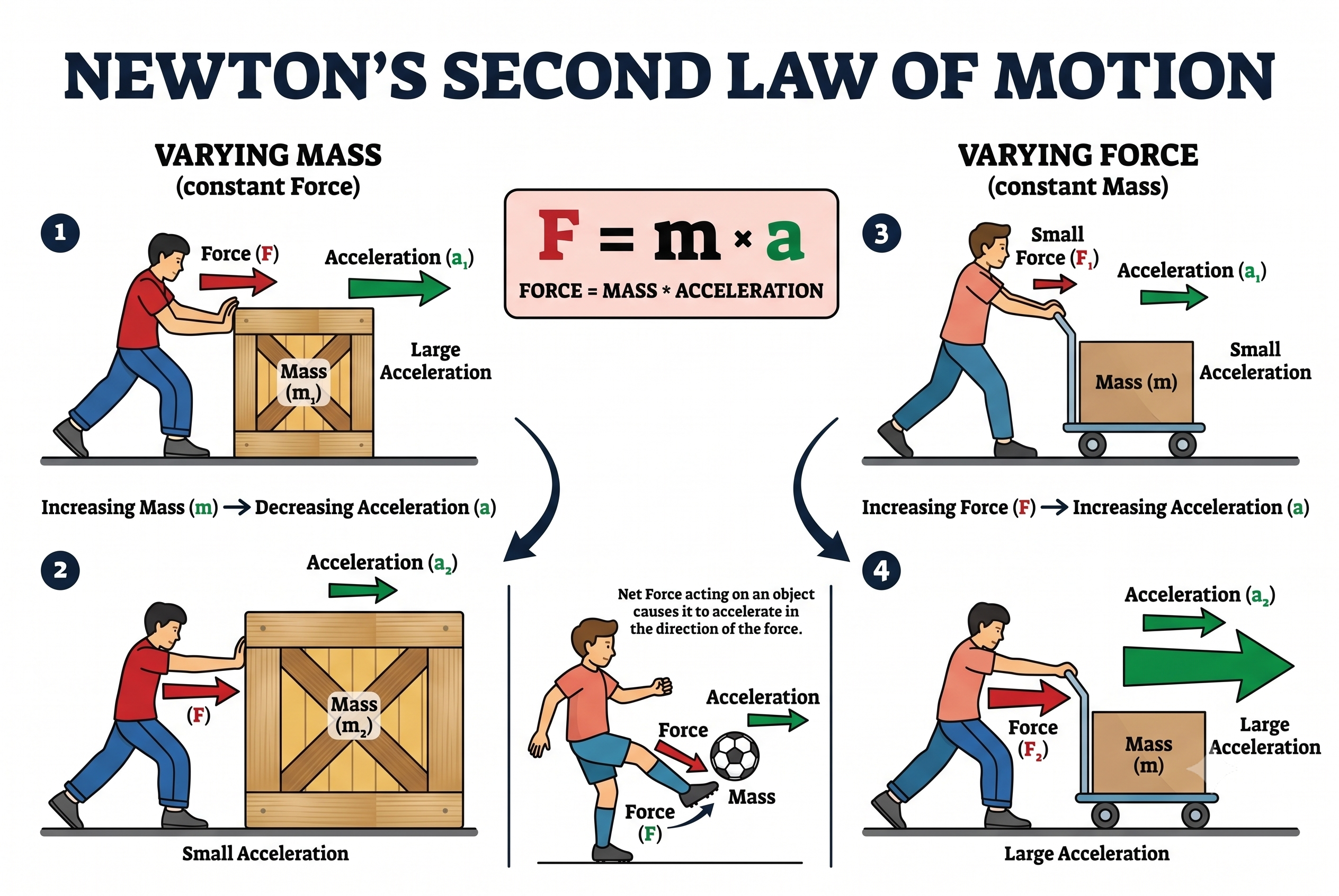
In words: the net force on an object equals its mass times its acceleration. Rearranged, it’s often more useful to think of it as:
Acceleration is what a net force produces. Mass is the object’s resistance to that production — its inertia. A bowling ball and a tennis ball can experience the same push, but the bowling ball, having far more mass, accelerates far less.
The part everyone forgets: “net”
The single most common mistake when applying this law is treating as if it were one force, rather than the vector sum of every force acting on the object. A box sitting on a ramp has gravity, a normal force, and possibly friction and an applied push all acting simultaneously. You have to add all of them — as vectors, respecting direction — before the equation means anything.
This is exactly why physics courses drill free-body diagrams: isolate the object, draw every force acting on it, break each force into components along convenient axes, and only then sum them up per axis.
It’s really three equations
Because force and acceleration are vectors, unpacks into one scalar equation per spatial dimension:
This is why choosing good coordinate axes matters so much in mechanics problems. On an incline, for example, it’s usually far easier to choose axes aligned with the slope (one axis along the ramp, one perpendicular to it) than to stick with strict horizontal/vertical axes — the same physics, but dramatically less algebra.
A worked example
Consider a block on a frictionless table, pulled by a horizontal rope with of tension, while gravity ( downward) is balanced exactly by the normal force from the table. Vertically, forces cancel, so . Horizontally, the only force is the tension:
The block accelerates at in the direction of the pull — nothing more complicated than dividing force by mass, once the diagram is right.
Now add friction. Suppose the table isn’t frictionless after all, and kinetic friction opposes the motion with a force of . The net horizontal force drops to , and:
Every additional force just gets folded into the same sum before you divide by mass. That’s the whole method — the difficulty in real problems is almost always in identifying and correctly projecting the forces, not in the final division.
The general form: force is really about momentum
Newton actually stated the second law in terms of momentum, :
When mass is constant, this reduces to the familiar , since . But the momentum form is more general — it correctly handles systems where mass itself changes over time, such as a rocket that accelerates partly by losing mass as it burns and ejects fuel. In those cases, alone gives the wrong answer, and you need the full momentum-based version.
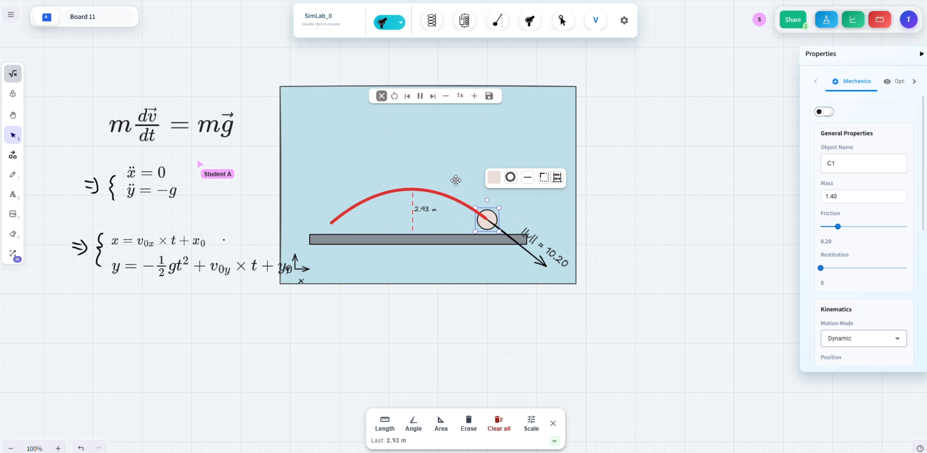
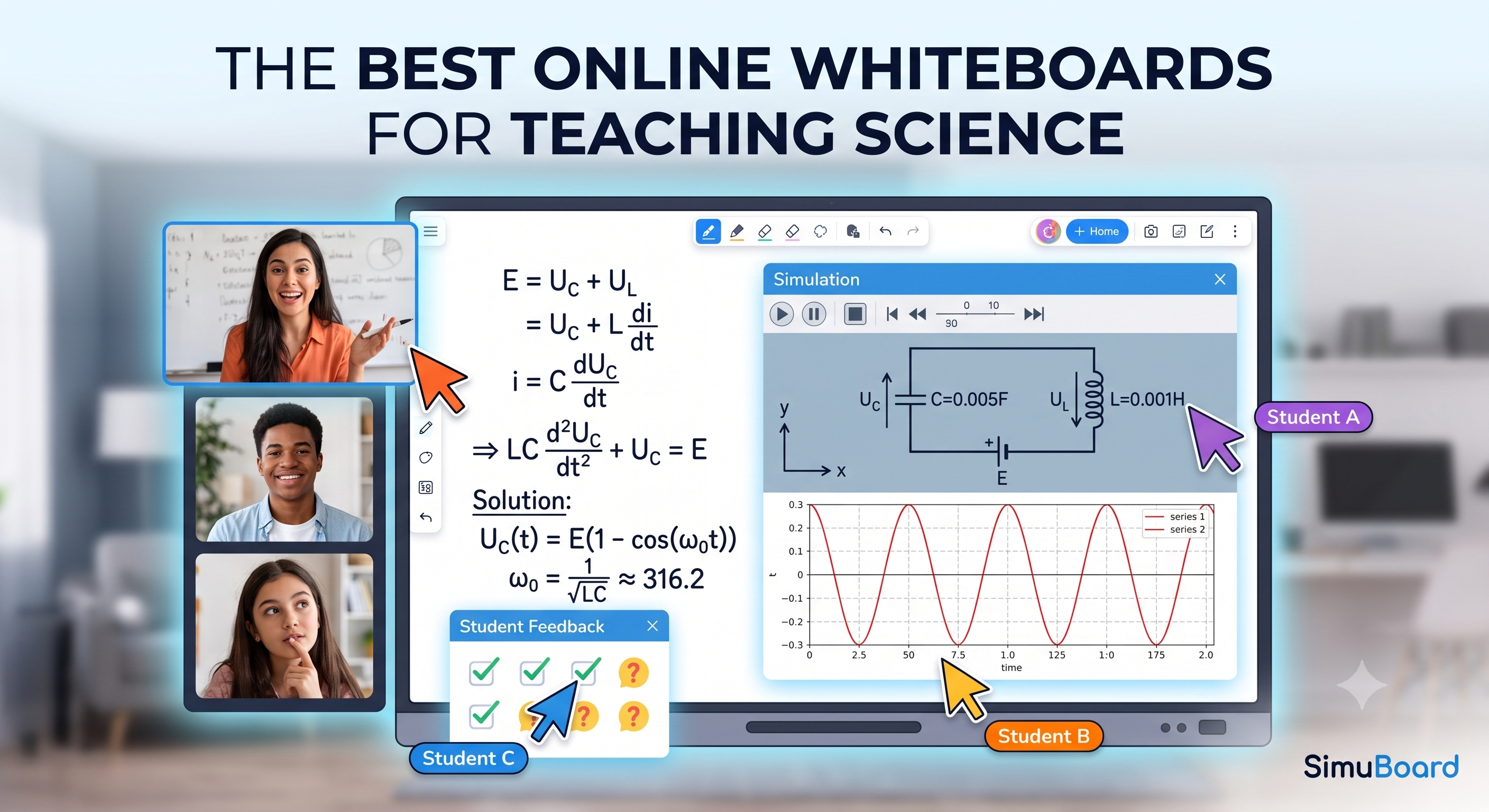
Build the intuition interactively: the fastest way to internalize how net force, mass, and acceleration relate is to change one variable at a time and watch what happens. SimuBoard’s mechanical engine lets you apply forces to rigid bodies on an infinite whiteboard and see the resulting acceleration play out immediately — useful for building the instinct that “more force, less mass, more acceleration” long before it becomes automatic.
Why this equation is everywhere
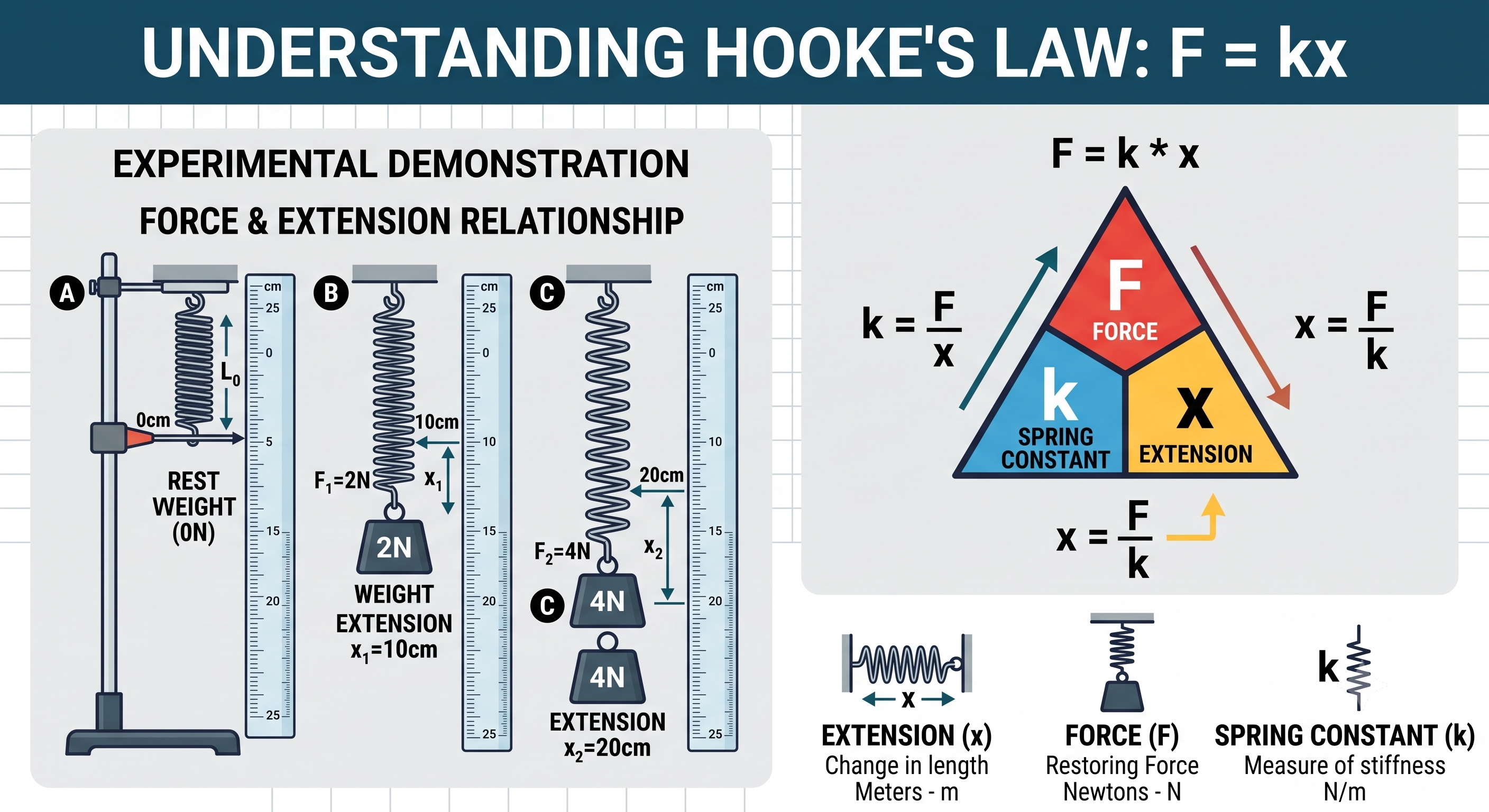
Nearly every topic in classical mechanics — projectile motion, circular motion, oscillations, orbital mechanics — is really just applied to a specific force law. Projectile motion is pointed downward. Orbital mechanics is Newton’s law of gravitation plugged into the same equation. Springs are Hooke’s Law plugged into the same equation. Once the second law is solid, most of “further” mechanics is just a matter of correctly identifying the forces involved and doing the vector bookkeeping.