If you’ve ever pulled back a slingshot, bounced on a trampoline, or watched a car’s suspension soak up a pothole, you’ve felt Hooke’s Law in action. It’s one of the first quantitative laws students meet in physics — deceptively simple to write down, and surprisingly deep once you start asking why it works and when it stops working.
The law itself
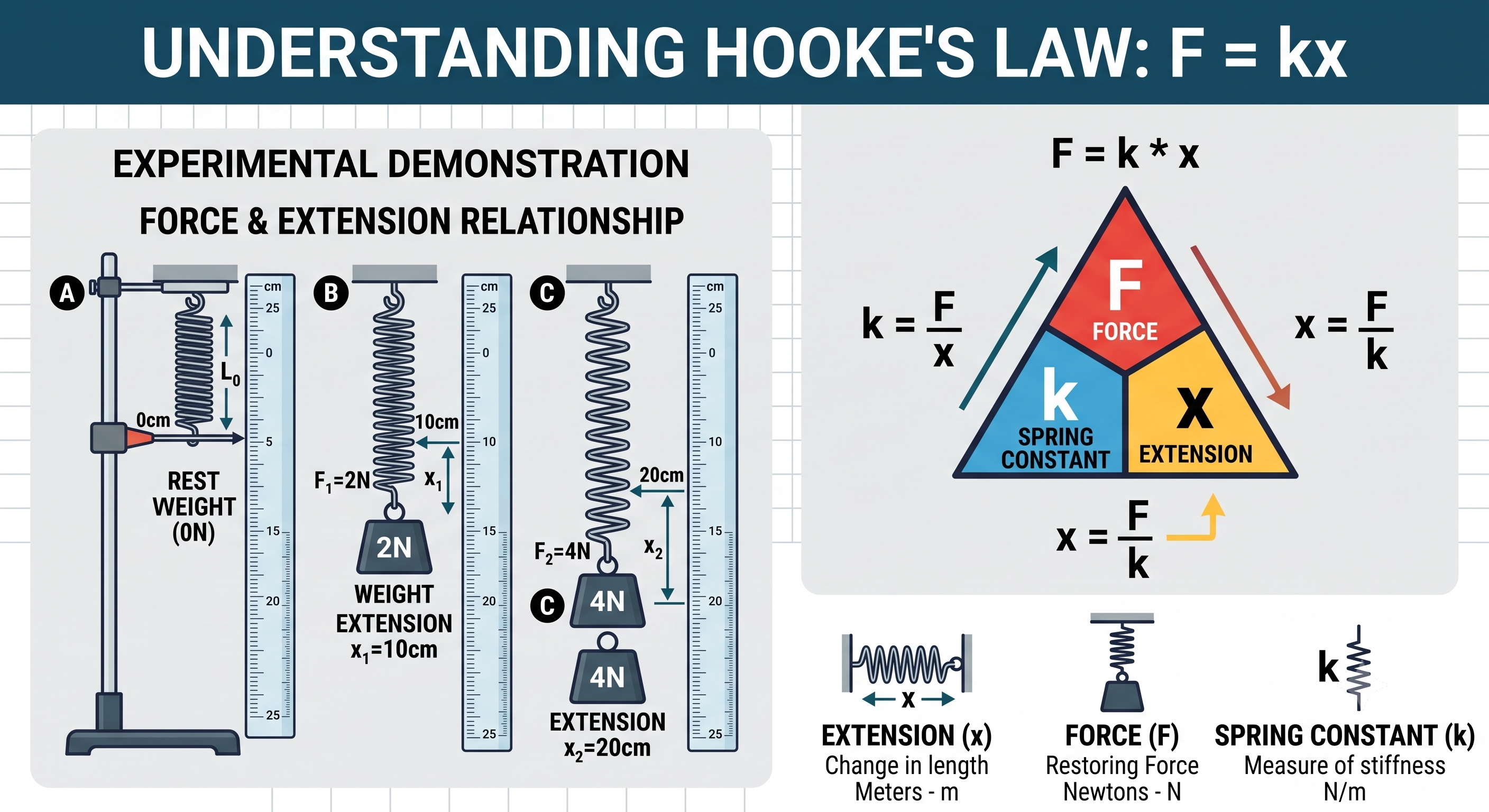
Hooke’s Law states that the force a spring exerts is proportional to how far it’s stretched or compressed from its natural length:
Here, is the displacement from the spring’s equilibrium (rest) position, is the spring constant — a measure of stiffness, in newtons per meter — and is the restoring force the spring exerts back on whatever is stretching or compressing it.
The minus sign is doing important work. It tells you the force always points opposite to the displacement. Pull the spring to the right, and it pulls back to the left. Compress it, and it pushes outward. This is what makes a spring a restoring force rather than just a resistive one — it doesn’t just resist motion, it actively drives the system back toward equilibrium.
Where the law comes from
English scientist Robert Hooke discovered this relationship experimentally in 1660, publishing it initially as an anagram (a common practice at the time to claim priority without revealing the result) that later decoded to “ut tensio, sic vis” — “as the extension, so the force.”
Physically, the linearity comes from the interatomic bonds inside the material. For small displacements, most materials behave like a network of tiny springs at the atomic level, and the restoring forces between atoms are approximately linear near their equilibrium spacing. Stretch things too far, however, and this approximation collapses — bonds break, materials yield, and the linear model no longer applies.
From force to motion: simple harmonic motion
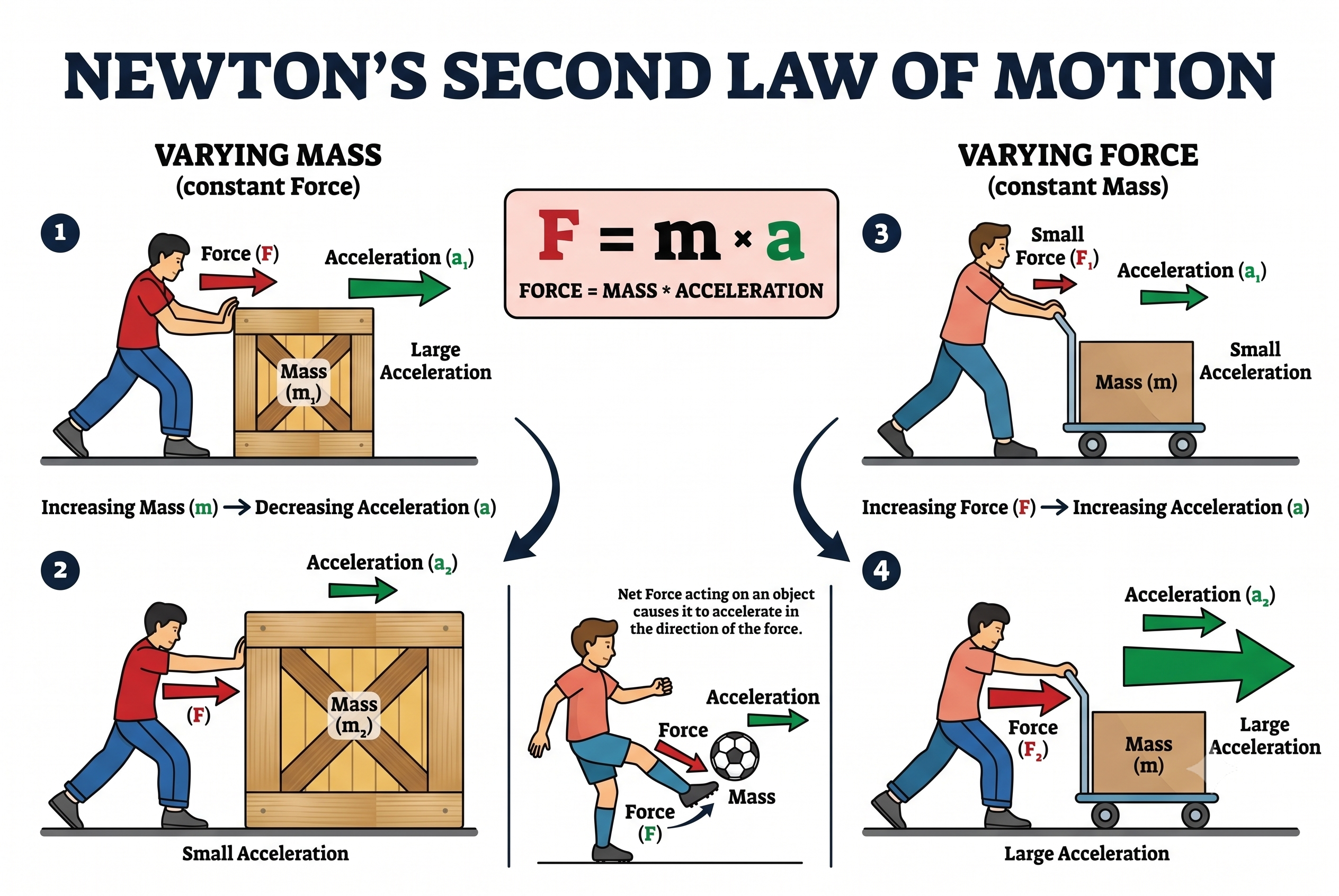
Hooke’s Law becomes much more interesting once you combine it with Newton’s Second Law. For a mass attached to a spring with no friction:
This is a second-order linear differential equation, and its solution is sinusoidal:
That’s simple harmonic motion (SHM) — the same mathematical pattern that shows up in pendulums (for small angles), vibrating guitar strings, AC electrical circuits, and even the quantum harmonic oscillator. Once you recognize the pattern, you start seeing it everywhere in physics.
A quick way to sanity-check the formula: a stiffer spring (larger ) oscillates faster (higher ), and a heavier mass (larger ) oscillates slower. Both match intuition.
Elastic potential energy
Because the spring force is conservative, it stores energy rather than dissipating it. Integrating the force over displacement gives the elastic potential energy:
This is why springs are used everywhere as energy-storage elements — from mechanical watches to vehicle suspensions to the launch mechanism in a pinball machine. In an ideal, frictionless spring-mass system, total mechanical energy stays constant, continuously trading between kinetic and potential energy as the mass oscillates.
Where Hooke’s Law breaks down
Real springs are only linear over a limited range, called the elastic region. Push past the elastic limit, and you enter the plastic region, where the material deforms permanently — it won’t return to its original shape even after the force is removed. Push further still, and the material fails entirely.
This is why engineers rarely design a spring to operate anywhere close to its elastic limit in practice: they build in a safety margin, because Hooke’s Law is a local, linear approximation of a relationship that’s fundamentally nonlinear at large displacements.
Real-world complications that go beyond the ideal model include:
- Damping — friction and air resistance drain energy from the system over time, so a real spring-mass system doesn’t oscillate forever; it decays toward equilibrium.
- Nonlinear stiffening or softening — some springs (like rubber bands) get stiffer as they stretch further, deviating from a constant .
- Mass of the spring itself — the ideal model assumes a massless spring; for very light masses attached to a heavy spring, this assumption breaks down.
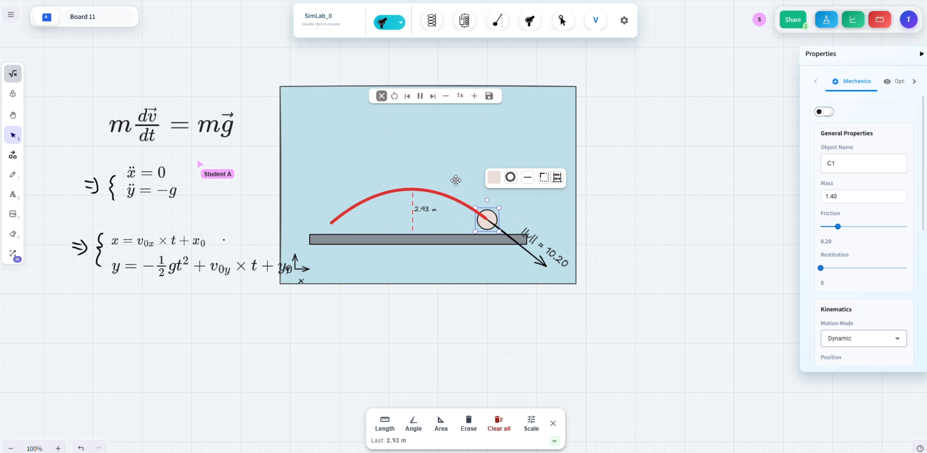
See it for yourself: the cleanest way to build intuition for the spring constant, damping, and simple harmonic motion is to actually change the parameters and watch the system respond in real time. SimuBoard’s mechanical simulation engine lets you drop a spring onto an infinite whiteboard, attach a mass, and tune stiffness and damping interactively — a fast way to see exactly where the linear approximation starts to break down.
A quick numerical example
Suppose a spring has and a mass is attached to it. The angular frequency of oscillation is:
That corresponds to a period of seconds — a little over three oscillations per second. Small changes to or shift this frequency in predictable ways, which is exactly the kind of relationship that’s much easier to feel than to memorize.
Hooke’s Law is a small equation with an outsized role in physics: it’s the gateway into oscillations, waves, and even the vibrational modes of molecules. Once the linear spring-force idea clicks, a surprising number of later topics start to look like variations on the same theme.