Ohm’s Law is often the very first equation students meet in electricity, and for good reason — it’s simple, useful, and lets you analyze a circuit with nothing more than arithmetic. But it’s also one of the most commonly misunderstood laws in physics, largely because it’s taught as a universal law when it’s really a property that only some materials have.
The equation
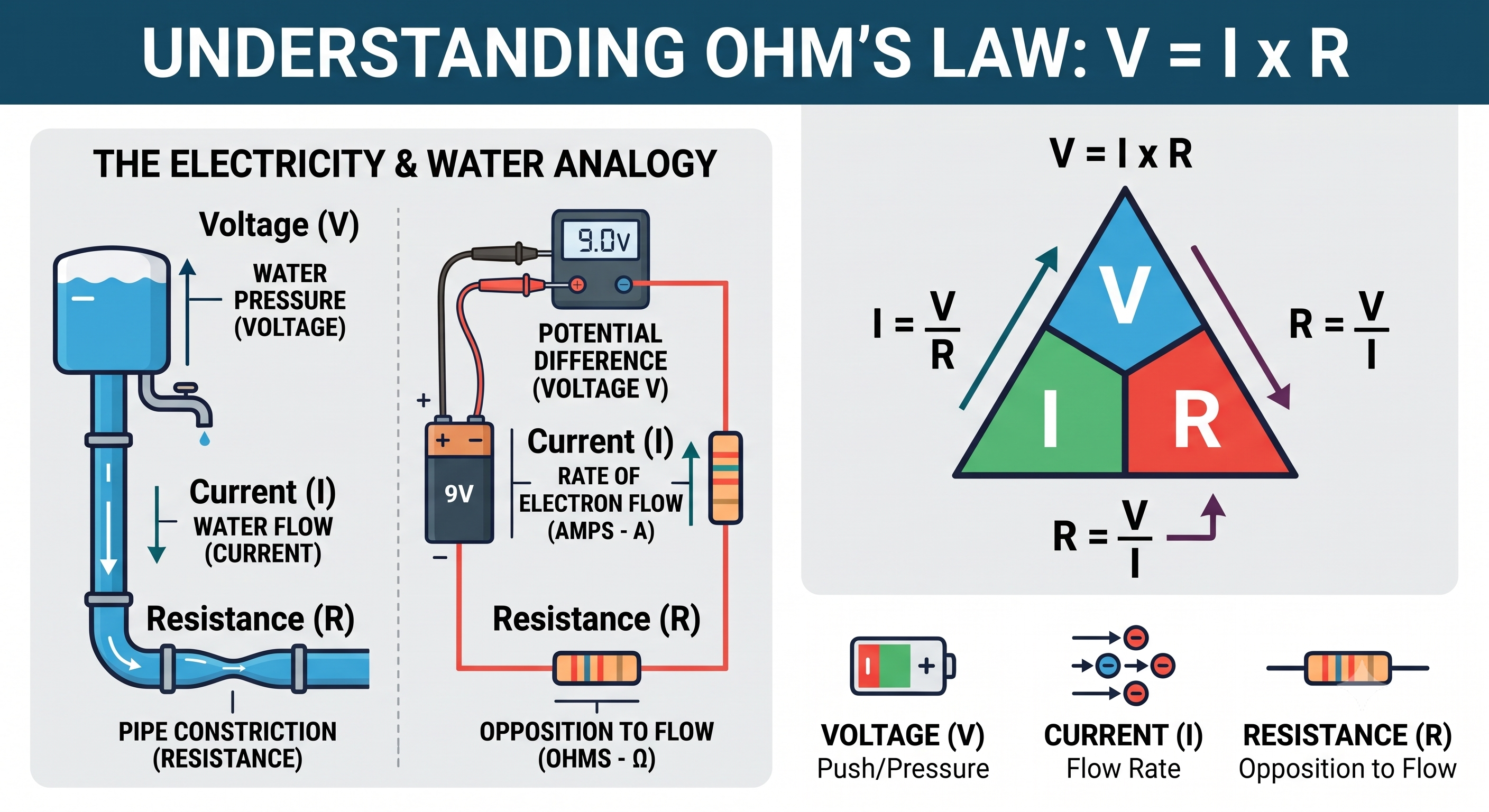
Voltage (in volts) across a component equals the current (in amperes) flowing through it, times its resistance (in ohms). Rearranged, resistance is the ratio of voltage to current for a given component:
A useful mental model: voltage is the “push” driving charge through a circuit, resistance is how much the material opposes that push, and current is the resulting flow. Higher push or lower opposition means more flow — exactly what says.
Why it’s called a “law” but isn’t really one
Georg Ohm published this relationship in 1827, based on careful experiments with wires of different materials, lengths, and thicknesses. What he found was that for many materials — metals in particular, at constant temperature — the ratio stays constant regardless of how much voltage you apply. That constant ratio is the resistance .
But this constancy is a property of the material, not a law of nature the way Newton’s laws are. Materials that maintain a constant across a wide range of voltages and currents are called ohmic. Many important components are decidedly non-ohmic:
- Diodes allow current to flow easily in one direction and barely at all in the other — their - curve is sharply nonlinear, not a straight line through the origin.
- Incandescent filaments heat up as current increases, which changes their resistance — so isn’t actually constant even though still technically defines an instantaneous resistance value.
- Semiconductors in general have resistance that depends heavily on temperature, doping, and applied voltage.
Ohm’s Law is best understood as: for ohmic materials, happens to be a constant, and describes their behavior well. For everything else, you still use to define resistance at an instant, but itself may vary.
Resistance versus resistivity
It’s easy to conflate resistance with resistivity, but they describe different things. Resistivity () is an intrinsic material property — copper and rubber have very different resistivities regardless of what shape you make them. Resistance depends on both the material and the object’s geometry:
where is the length of the conductor and is its cross-sectional area. A long, thin wire has more resistance than a short, thick one made of the same material — which is exactly why household wiring uses thick copper cables (low resistance, minimal energy loss) while a heating element intentionally uses a thin, high-resistivity wire (high resistance, generating heat on purpose).
Applying Ohm’s Law to real circuits
The real value of Ohm’s Law shows up once you start combining multiple resistors.
Resistors in series all carry the same current, so their voltage drops add up, and effectively:
Resistors in parallel all see the same voltage, but the current splits between them, so it’s the conductances (reciprocals of resistance) that add:
A quick sanity check: two identical resistors in parallel behave like a single resistor of — twice the paths for current to flow means half the effective resistance. In series, the same two resistors behave like — twice the material for current to push through means twice the resistance.
A worked example
Suppose a 9V battery drives a circuit with a resistor in series with two resistors in parallel with each other. First, combine the parallel pair:
Then add the series resistor: . The current drawn from the battery is:
From there, Ohm’s Law applied locally tells you the voltage drop across any individual resistor, and Kirchhoff’s current law tells you how that 45 mA splits between the two parallel branches.
Wire it up and watch it work: the fastest way to build intuition for series and parallel resistance is to actually assemble a circuit and watch current flow through it. SimuBoard’s electrical simulation engine lets you place resistors, batteries, and wires on an infinite whiteboard and solves the circuit numerically in real time, so you can change a resistance value and immediately see every current and voltage in the circuit update.
Why this equation still matters everywhere
Even where Ohm’s Law doesn’t hold exactly, it remains the reference point every more complex electrical model is compared against. Nonlinear devices are often described by a “small-signal resistance” — effectively a local, momentary version of Ohm’s Law valid near one operating point. Power dissipation, too, builds directly on it: , three equivalent ways of expressing the same energy loss, all stemming from the same simple relationship between voltage, current, and resistance.